


What Goes in a Roll-Off Dumpster and What Doesn’t: Prohibited Materials NYC Contractors Get Wrong

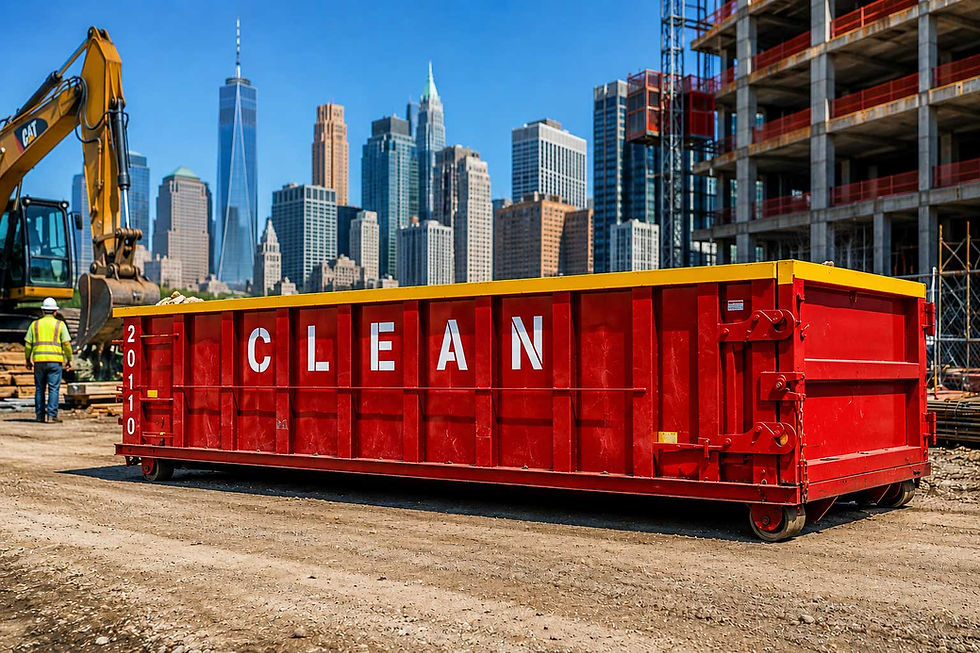
A rejected roll-off container rarely starts with intentional rule-breaking. More often, it starts with one prohibited item loaded into an otherwise acceptable container. By the time the load reaches the receiving facility, the project is dealing with extra hauling costs, schedule delays, and disposal documentation problems that weren’t in the plan.
There is also a more fundamental issue: not every hauler in New York City is legally authorized to remove construction and demolition debris. All C&D waste in the five boroughs must be hauled by a company licensed by the NYC Business Integrity Commission (BIC). Hauling without a BIC-licensed carting company qualifies as illegal dumping, and that liability falls on the contractor. Clean Carting holds BIC # 504171 and has been hauling from NYC and Westchester job sites since 2009. Here is what the regulations require.
What a Construction Roll-Off Dumpster Is For
Under NYSDEC regulations, a C&D container accepts one category of waste: uncontaminated solid waste from the construction, remodeling, repair, and demolition of structures and roads. Acceptable materials include concrete, brick, masonry, non-asbestos roofing shingles, clean gypsum wallboard, untreated unpainted dimensional lumber, tile, carpeting, glass, and asphalt pavement. Excavated soil is acceptable only when there is no evidence of contamination, no unusual odor, no discoloration, and no known spill history on the site.
What the NYSDEC Explicitly Prohibits
These materials are not considered C&D debris under current NYSDEC regulations, regardless of where they came from on a job site. C&D debris handling and recovery facilities are prohibited from accepting them:
Municipal solid waste and garbage
Friable asbestos-containing waste
Corrugated cardboard
Furniture and appliances
Tires
Drums and fuel tanks
Solar panels
Fluorescent lights, light ballasts, and transformers containing hazardous liquids
Any container over ten gallons with more than one inch of residue at the bottom
Pre-demolition cleanouts are where this causes problems. Old furniture, appliances, fluorescent fixtures, and solar equipment come out alongside framing and masonry, but none of it belongs in the C&D container. Those items need separate disposal arrangements before loading begins.
Treated and Painted Wood: Where the Rules Get Specific
Clean dimensional lumber is acceptable. Painted wood, plywood, particle board, fiberboard, and glued composites are not acceptable at C&D processing facilities. Vinyl and laminate flooring also go to trash, not to a C&D facility.
One clarification on pressure-treated lumber: CCA-treated wood (chromated copper arsenate) can be accepted at permitted C&D landfills in New York State, but it cannot be chipped at a processing facility or burned. When in doubt about a specific treated product, confirm with the hauler before loading. Mixed loads of clean framing lumber, painted trim, and composites create rejection risk. Sort at the container, not after the load comes back.
Asbestos: A Completely Separate Chain of Custody
Asbestos-containing material does not go in a roll-off under any circumstances. The NYC DOB requires an ACP-5 form (Asbestos Project Certification) with all alteration and demolition permit applications. If a certified asbestos investigator finds that friable asbestos is present and will be disturbed, an ACP-7 (Asbestos Project Notification) must be filed with the NYC DEP at least seven days before work begins. Friable material must be removed by a licensed abatement contractor, containerized to DEP specifications, and transported to a DEP-approved site. It leaves the job in sealed, labeled containers, not in a standard dumpster.
Failure to survey or file notification carries DEP penalties of $1,200 to $10,000 per infraction. Under NY Labor Law Section 909, initial violations carry penalties up to $2,500; repeat violations up to $4,000; prior offenders face up to the greater of 50% of contract value or $25,000 per violation, with each continuing day potentially counted separately.
The DOB exempts buildings constructed after April 1, 1987 from certain DEP certification requirements, but the DEP’s own guidance states asbestos can be found in almost all buildings constructed prior to 1989. Any building where suspect materials will be disturbed warrants investigation.
NYC Soil Disposal Rules Are Different
Excavated fill is acceptable in a C&D roll-off only when it is clean: no staining, no petroleum odor, no spill history. Contaminated soil is hazardous waste and requires its own manifest and licensed disposal facility.
The NYC-specific rule most contractors don’t know: soil from any of the five boroughs can only go to a NYSDEC-registered C&D facility that is owned or controlled by the City of New York. A hauler routing five-borough excavation soil to a standard registered processor outside the city is not in compliance. Before a container of excavated material leaves the site, confirm the destination.
What Happens When a Load Gets Rejected
When a transfer facility rejects a contaminated container, the load comes back. Material gets sorted and separated. Compliant debris gets re-hauled. Prohibited items go to separate disposal streams. A second haul gets scheduled. The project takes an unplanned cost and schedule hit.
The DOB, DSNY, and NYSDEC can all request disposal documentation at inspections and project close-out. Hauler license numbers, manifests, and transfer facility receipts are the paper trail that protects a contractor. A rejected and re-handled load creates gaps in that documentation that are hard to explain during an audit.
Who Is Responsible
The BIC license belongs to the hauler. Confirming it is current before debris leaves the site is the contractor’s job. What goes into the container is also the contractor’s responsibility. Licensed hauler, compliant load, complete documentation. All three.
Sorting at the Container Pays Off
Concrete and masonry separated from mixed debris moves more efficiently through recycling. Scrap metal pulled from the load may return value and eliminates a contamination issue. Clean lumber separated from composites and painted wood keeps the load compliant. Investing in separation during loading consistently costs less than sorting after a rejection.
Construction Dumpster Rental in NYC and Westchester
Clean Carting provides roll-off dumpster rentals for construction and demolition projects across all five boroughs and Westchester. Same-day and scheduled service available. For questions about container sizing, acceptable materials, or what your project generates, call or text 718-200-7037 or visit cleancarting.com.
Primary Sources and Regulatory References
All regulatory claims in this article are drawn from the following primary sources. Regulations are subject to change; readers are encouraged to verify current requirements directly with the issuing agency.
NYC Department of Sanitation (DSNY)
Construction Debris — Professional Projects and Disposal Requirements https://www.nyc.gov/site/dsny/collection/get-rid-of/construction-debris.page
NYS Department of Environmental Conservation (NYSDEC)
New York State’s Solid Waste Program — C&D Debris Definition and Prohibited Materials https://dec.ny.gov/environmental-protection/waste-management/solid-waste-program/ny-solid-waste-program
Construction and Demolition Debris Handling and Recovery Facilities — Prohibited Materials and Registration Requirements https://dec.ny.gov/environmental-protection/waste-management/solid-waste-management-facilities/construction-demolition-debris-processing
Asbestos — Friable Asbestos-Containing Waste, Transportation and Disposal https://dec.ny.gov/environmental-protection/waste-management/solid-waste-types/construction-demolition-debris/asbestos
CCA-Treated Lumber — Disposal in C&D Debris Landfills https://dec.ny.gov/environmental-protection/waste-management/solid-waste-types/construction-demolition-debris/lumber-pressure-treated
NYC Department of Environmental Protection (DEP)
Asbestos Abatement — Survey Requirements, Filing Deadlines, and Penalty Schedule https://www.nyc.gov/site/dep/environment/asbestos-abatement.page
NYC Department of Buildings (DOB)
Project Requirements: Asbestos — ACP-5 and ACP-7 Form Requirements https://www.nyc.gov/site/buildings/dob/project-requirements-asbestos.page
NYC Business Integrity Commission (BIC)
Business Integrity Commission — Trade Waste Licensing and Customer Information https://www.nyc.gov/site/bic/industries/customer-information.page
New York State Legislature
New York Labor Law § 909 — Civil Penalties and Revocation (Asbestos Contractors) https://www.nysenate.gov/legislation/laws/LAB/909


Comments